Lighting a sports court well in Singapore is mostly geometry, not wattage. A high-lumen flood light aimed wrong gives a worse playing surface than a lower-lumen flood light aimed right. The three parameters that decide the result are average maintained lux, the uniformity ratio (minimum-to-average), and glare control rating.
Lux levels by court type — practical starting points
- Recreational badminton / basketball: 300 lux average maintained
- Club-level training: 500 lux average maintained, uniformity ≥ 0.6
- Competitive / televised: 750+ lux average maintained, uniformity ≥ 0.7, strict glare limits
- Tennis recreational: 300 lux at the playing surface
- Squash recreational: 300 lux, with attention to walls (vertical lux matters)
- Volleyball recreational: 300 lux average maintained
- Futsal / 5-a-side outdoor: 200–300 lux average, weather-rated luminaires
These are working targets — the specific competition body (BWF, ITF, FIBA) may publish a stricter table for sanctioned events.
Pole layout matters more than luminaire choice
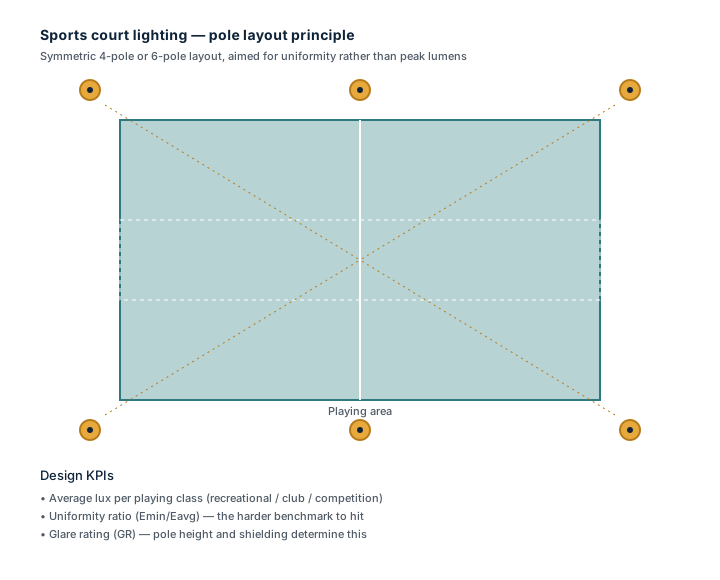
A typical badminton hall lights from above with downlight or high-bay luminaires aimed straight down. A typical outdoor tennis court lights from four poles, two each side, with flood luminaires aimed across the court — not down — to limit glare to the player looking up at a lob. A basketball court splits the difference: corner poles aimed inward at the key, with cross-aiming to reduce shadow.
Squash courts are different
Squash lighting is vertical-surface lighting, not horizontal-surface lighting. The ball travels up to and off the front wall. Lighting must reach the walls evenly without shadow lines, which is why squash courts use diffused linear LEDs across the ceiling rather than concentrated downlights.
Glare control
Glare control rating (GR) is a number specified by the luminaire manufacturer. Modern LED sports floodlights publish GR limits at given mounting angles. For recreational courts, GR ≤ 50 is workable. For competitive, GR ≤ 40. Visors and asymmetric reflectors reduce GR but only if aimed within their design envelope.
Circuit and switching
For multi-court venues we split the lighting across at least two circuits per court so a single fault does not dark out the whole game. Switching is typically split into halves — for example two of four poles on one switch, the other two on a second — so that warm-up does not need full power. Smart timers and motion sensing reduce burn-hours on lightly-used outdoor courts.
Aim during operating hours, not at install
The right way to commission a court is to aim luminaires during play, with the actual ball in the actual condition. A perfectly aimed luminaire at 11pm on an empty court can still be wrong at 8pm with a full game on.